메이즈, 프라이버시 퍼스트 리테일 인텔리전스의 뉴글로벌 표준 수립... 시리즈A 투자 유치,미국 진출 본격화
by
2026년 2월 24일

With the DOJ, EU, China, and state AGs all circling — and California's top prosecutor calling it "not a done deal" — the merger's path to closing could take well over a year.
Netflix walked away. Paramount Skydance stepped in. And now the real fight begins. The blockbuster acquisition of Warner Bros. Discovery must survive a four-front regulatory war — the U.S. Department of Justice, the European Union, Chinese regulators, and a bipartisan coalition of state attorneys general — before it can reshape the global streaming landscape.
California Attorney General Rob Bonta threw cold water on the celebration within hours, declaring the deal "not a done deal." With antitrust investigations now averaging a record 12.3 months, a junk credit rating, and political pressure coming from both sides of the aisle, the price of ambition has never been higher.
 Jung Han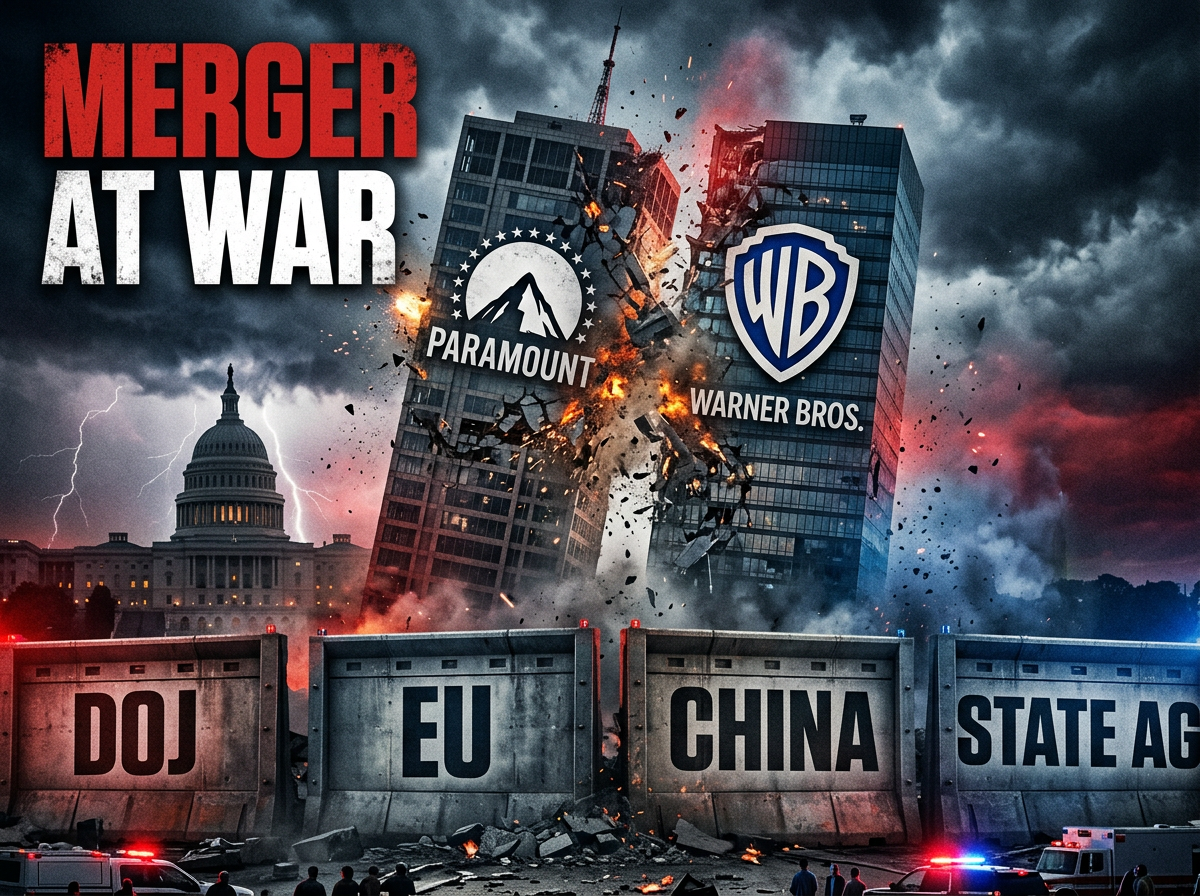
When Netflix co-CEO Ted Sarandos was spotted leaving the White House on February 26, speculation ran wild. Democratic lawmakers alleged that a meeting with Trump administration officials had effectively pushed Netflix out of the WBD bidding war, handing the deal to Paramount. Senators Warren and Schiff pointed to potential inside influence after Trump's self-described "good friend" David Ellison seemingly secured his second legacy studio in less than two years.
The reality was far less dramatic. According to sources familiar with the matter, Sarandos was informed shortly after arriving that his meeting had been canceled due to a last-minute scheduling conflict — and he promptly left the building. The only officials he met in Washington that day were from the Department of Justice, and those conversations were described as productive. DOJ officials never threatened Netflix and signaled they intended to run a fair process.
President Trump did speak with Sarandos by phone that evening — but only after Netflix had already publicly announced it would not raise its bid. Sarandos told Bloomberg the company had already made that call independently. One source noted that when Trump and Sarandos had previously discussed the deal, the president had advised him not to overpay for the asset.
The Justice Department has confirmed it is investigating the merger — standard procedure for a deal of this magnitude. But Paramount's approach to the regulatory process has been anything but standard. The company's regulatory strategy is led by Makan Delrahim, the former DOJ antitrust chief, who filed the pre-merger notifications required under the Hart-Scott-Rodino (HSR) Act before a formal merger agreement was even signed.
The move is legal, but unusual. By front-loading the HSR clock, Paramount has compressed the window in which the DOJ could sue to block the transaction. Antitrust experts do not expect the department to ultimately challenge the deal, but the longer overseas approval timelines stretch — potentially 12 months or more — the more time federal and state prosecutors have to build a case.
The core antitrust argument available to challengers is market concentration. Samuel Weinstein, a former DOJ antitrust attorney and professor at Cardozo School of Law, put it plainly: "The most viable antitrust argument is reducing five studios to four, and having fewer bidders for services." The ripple effects could reach content licensing, theatrical distribution, and creator employment across the industry.
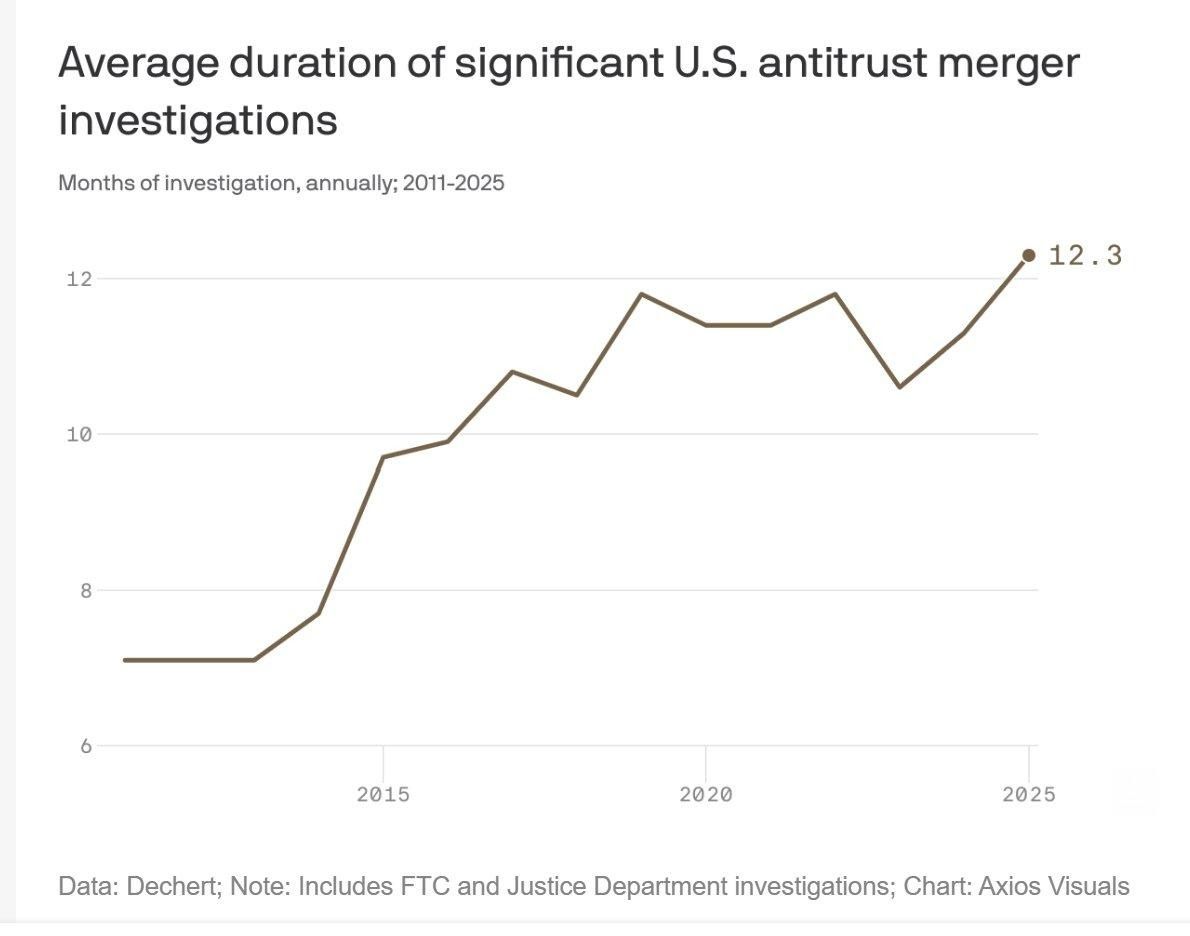
▲ Average duration of significant U.S. antitrust merger investigations hit a record 12.3 months in 2025. (Data: Dechert / Chart: Axios Visuals)
While Paramount was popping champagne corks over David Ellison's successful bid, the mood in Sacramento was anything but celebratory. California Attorney General Rob Bonta wasted no time making his position known, telling Deadline on the evening of February 26 — the same day Netflix formally exited the race — that the deal was far from finished.
"Paramount/Warner Bros is not a done deal. These two Hollywood titans have not cleared regulatory scrutiny — the California Department of Justice has an open investigation, and we intend to be vigorous in our review."
— Rob Bonta, California Attorney General, February 26, 2026
Bonta had first signaled his scrutiny a week earlier, on February 20, when the California DOJ opened a probe covering any potential WBD acquisition — whether by Netflix or Ellison's team. At the time, he framed the review in stark economic terms: "The film and entertainment industry not only has historical importance to our state, it also is a critical sector that buoys the economy of California and touches the lives of Americans daily. The proposed Warner Brothers transactions must receive a full and robust review, and California is taking a very close look."
What makes the political pressure environment particularly difficult for Paramount is that it is genuinely bipartisan. Eleven Republican attorneys general — from Montana, Alabama, Alaska, Iowa, Kansas, Nebraska, North Dakota, South Carolina, Tennessee, Utah, and West Virginia — wrote to federal Attorney General Pam Bondi on the day of the State of the Union, urging scrutiny of what was then the Netflix-WBD proposal. Their letter warned that the deal would "likely result in undue market concentration that stifles competition and therefore creates higher prices, lower reliability, and less innovation." The logic applies with equal force to the Paramount version of the deal.
On the Democratic side, Senator Elizabeth Warren has already predicted an "antitrust disaster," while Senator Adam Schiff of California called for the "highest levels of scrutiny, free from White House political influence" — explicitly citing concern that Ellison, described as a Trump "good friend," was poised to acquire his second major studio in under two years. "What was true for Netflix," Schiff said, "is still true now for Paramount."
California Governor Gavin Newsom — who championed a $750 million expansion of the state's film and TV tax credit program last year to boost production and employment — has not yet publicly weighed in on the merger. Given his track record of confronting the Trump administration on major economic and cultural issues, his silence is likely temporary.
Domestic pressure is only part of the picture. The European Union will conduct its own merger review, a process that typically runs longer than U.S. proceedings. While antitrust experts expect Brussels to ultimately clear the deal, the review timeline adds months to the approval calendar — and the longer it runs, the more runway domestic challengers have to assemble their case.
China adds a further layer of uncertainty. Because the merged company will control two major Hollywood studios with established Chinese distribution operations, Beijing's sign-off is required. The current state of U.S.-China relations makes that timeline and outcome genuinely unpredictable.
One area where Paramount appears to have secured its flank is national security. The Committee on Foreign Investment in the United States (CFIUS) is not expected to intervene, despite regulatory filings indicating that roughly 60% of the $40 billion in equity came from sovereign wealth funds linked to Saudi Arabia, Abu Dhabi, and Qatar. Paramount has pledged that foreign partners will hold no voting rights or governance authority over the combined entity.
The reason Paramount is willing to absorb these regulatory and financial risks comes down to scale. Combining Paramount+ and HBO Max would create a platform with approximately 210 million subscribers — still well short of Netflix's 325 million, but enough to establish a credible second-place challenger in the streaming wars.
Markets, however, remain skeptical. After Fitch Ratings downgraded Paramount's debt to junk, shares fell more than 6% in a single session. The central question for investors is whether the enormous debt burden being assumed to compete in streaming will ultimately prove justified — or whether it amounts to an expensive gamble on a race already decided.
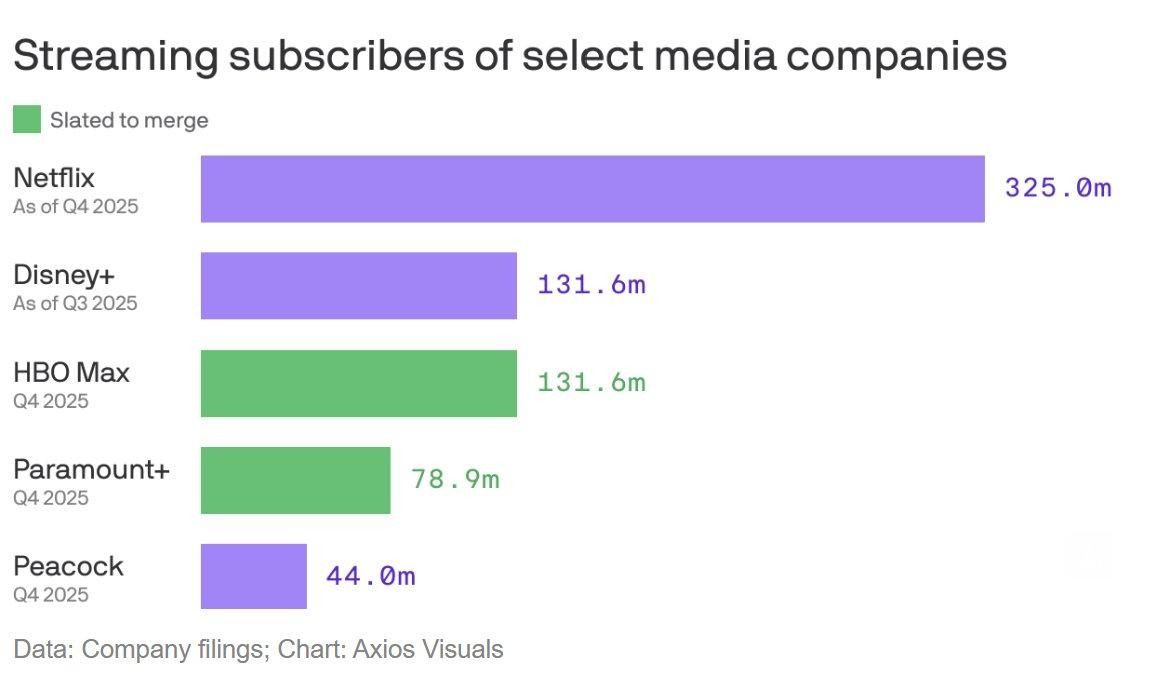
▲ Streaming subscriber counts for select media companies (2025). A combined HBO Max + Paramount+ would reach ~210M subscribers, placing second behind Netflix's 325M. (Data: Company filings / Chart: Axios Visuals)
The urgency behind the deal becomes clearer when viewed against the broader collapse of traditional television. Versant — the Comcast spinoff that owns CNBC, MS Now, and USA Network — reported advertising revenue fell 8.9% in 2025. CEO Mark Lazarus has set a target of growing non-pay-TV revenue from 19% to 33% of total within three to five years. The old model is running out of road.
The Paramount-WBD merger is the industry's biggest bet against that decline. But with antitrust investigations running at a record 12.3-month average, a junk credit rating, a bipartisan pressure campaign from state attorneys general, and EU and Chinese reviews still pending — the path from ambition to execution is anything but certain. As California's AG made clear the moment the deal was announced: this is not a done deal. And it won't be for a long time.

![[Samseog Ko's Insight]Seoul's Moment: Becoming the World's Global Entertainment tech Hub](https://cdn.media.bluedot.so/bluedot.kentertechhub/2026/02/icu6an_202602170621.png)



![[보고서]전통 언론사의 크리에이터 전략 대전환](https://cdn.media.bluedot.so/bluedot.kentertechhub/2026/02/0nwc9z_202602100212.png)