황혼의 케이블, 여명의 팟캐스트...뉴스 유통의 중심이 되고 있는 팟캐스트
by
2026년 2월 18일
MEDIA INDUSTRY ANALYSIS
The Death of the RSN, The Dawn of a New MLB Era
The Collapse of America's Regional Sports Networks and the Rise of MLB's Direct-to-Consumer Streaming Age
In February 2026, an era in American sports broadcasting came to an end. FanDuel Sports Network, which once carried local game broadcasts for 29 professional sports teams and served as a cornerstone of the U.S. sports media ecosystem, ceased operations. Its parent company, Main Street Sports Group, failed to secure a buyer or additional financing, plunging back into a liquidation crisis barely a year after emerging from bankruptcy protection in early 2025. All nine of its MLB-affiliated teams have already terminated their contracts, and NBA and NHL teams are set to depart following the conclusion of their regular seasons in mid-April 2026.
 Jung Han
This is not merely the demise of a single network. It is a signal flare marking the end of the Regional Sports Network (RSN) business model itself — a financial pillar that sustained the American professional sports industry for decades. And on the ruins of that model, Major League Baseball is launching an entirely new experiment: league-controlled direct media operations.
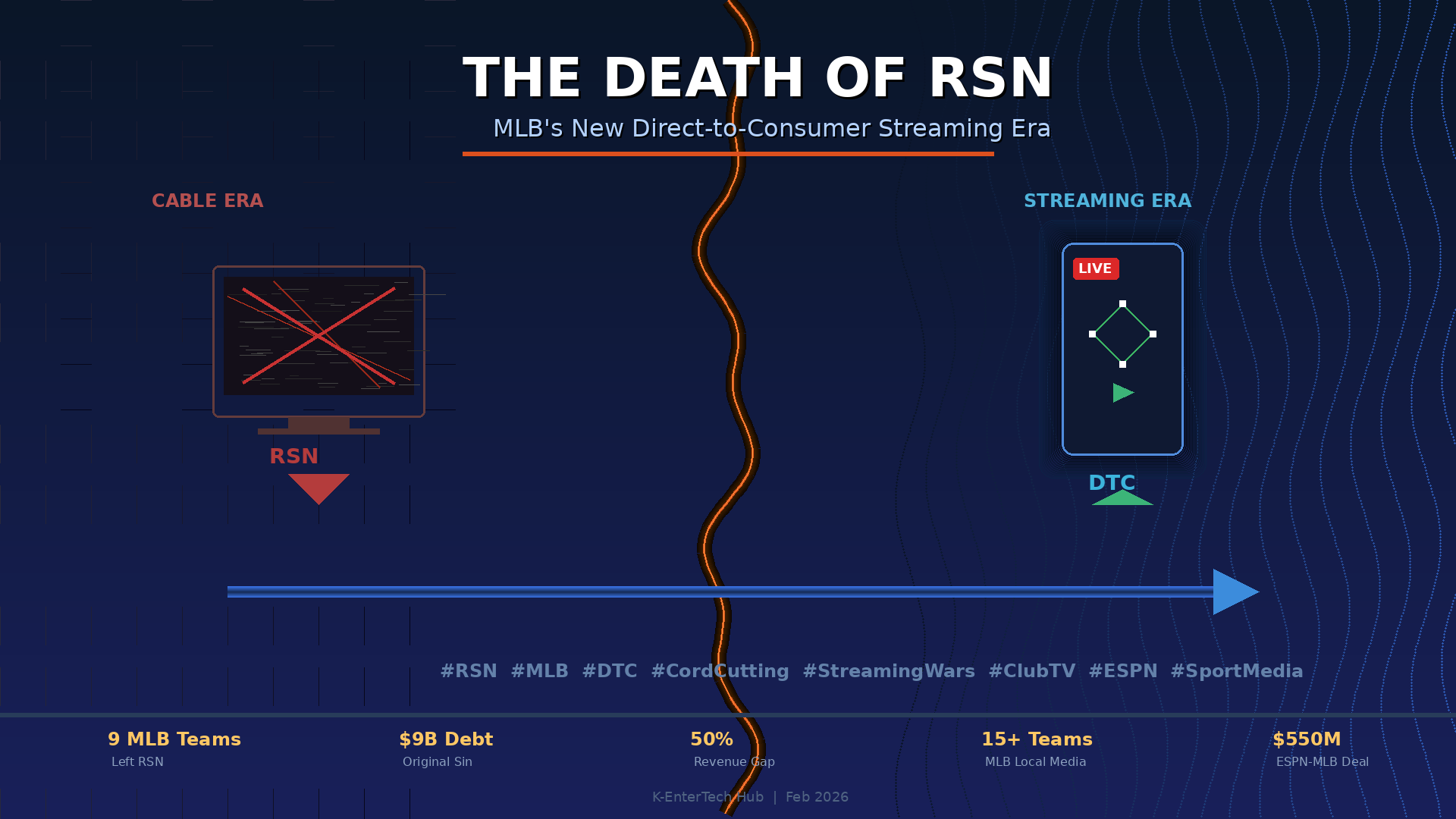
RSN stands for Regional Sports Network — a cable television channel that holds exclusive rights to broadcast a specific region's professional sports teams. A uniquely American system, RSNs have been the primary vehicle for delivering home games of MLB, NBA, and NHL teams to local fans. Iconic examples include the New York Yankees' YES Network, Boston's NESN, and the New York metro area's MSG Network.
The RSN business model was structurally rooted in the cable TV ecosystem. Cable operators sold channel bundle packages to subscribers, embedding RSNs within premium tiers. The critical mechanism was that even subscribers with zero interest in sports were indirectly paying for RSN channels through their bundle fees — a structure known as the 'bundle subsidy.' As one industry analyst aptly put it: "Grandma in Boca Raton was paying $8 a month for a sports channel she never watched so that the Marlins could sign a shortstop."
Thanks to this system, RSN deals represented a fixed, reliable income source comprising 20–30% of a team's total revenue. The YES Network alone generated over $143 million in 2023. RSN contracts were the financial bedrock of team operations and the critical funding source for player payrolls.
▼ The RSN Business Model: Core Structure
The origins of the RSN collapse trace back to 2019. When Disney acquired 21st Century Fox, antitrust regulations required the divestiture of Fox's 22 regional sports networks. Sinclair Broadcast Group stepped in to buy them. The problem was the price tag: Sinclair saddled the acquisition with nearly $9 billion in debt. Industry observers compared it to "trying to swim the English Channel wearing a suit of armor." The bet was predicated on a worldview that had already expired around 2015 — the assumption that cable subscribers would continue paying bloated bundle fees in perpetuity. They wagered on the status quo just as the status quo was packing its bags and moving to Netflix.
The COVID-19 pandemic accelerated a decline that had already begun. Cable subscriber counts plummeted by up to 40% in some markets, and rights fee contracts negotiated during the boom era grew increasingly detached from reality. Sinclair's RSN division, Diamond Sports Group, filed for Chapter 11 bankruptcy protection in March 2023. After approximately 20 months of legal wrangling, the company completed its restructuring and relaunched in early 2025 as Main Street Sports Group.
But the name change solved nothing. The new company struck a naming rights deal with sportsbook giant FanDuel, rebranding to 'FanDuel Sports Network,' and signed a commercial agreement with Amazon. Yet cord-cutting continued to accelerate, and revenue erosion from cable subscriber losses persisted. In late December 2025, the company missed a rights fee payment to the St. Louis Cardinals, triggering a mass exodus. By January 2026, all nine of its MLB teams had terminated their contracts. The global streaming giant DAZN explored an acquisition but ultimately walked away, dashing Main Street's last hope for a lifeline.
▼ RSN Collapse Timeline
While the RSN model was crumbling, MLB had been proactively preparing. In 2023, the league established 'MLB Local Media,' a dedicated division within the league office. Its mandate: directly produce local broadcasts for teams that lose their RSN deals, negotiate distribution agreements with cable and satellite providers, and operate direct-to-consumer (DTC) streaming services.
Heading into the 2026 season, MLB Local Media's scope has expanded dramatically. Six teams departing FanDuel Sports Network — the Milwaukee Brewers, Miami Marlins, Kansas City Royals, St. Louis Cardinals, Cincinnati Reds, and Tampa Bay Rays — joined a growing roster that already included the San Diego Padres, Cleveland Guardians, Seattle Mariners, Minnesota Twins, Arizona Diamondbacks, Colorado Rockies, and Washington Nationals. The Detroit Tigers and Los Angeles Angels have since been added as well. As of the 2026 season, MLB is directly managing broadcasts for at least 15 of its 30 teams — half the league.
MLB Commissioner Rob Manfred has repeatedly stated that "the league is prepared to step in whenever RSN deals fall apart." His long-term vision is even more ambitious. Manfred has publicly outlined a strategy to consolidate local and national media rights into a single negotiating package by the time the current national broadcast deals expire after 2028, maximizing the league's total media value.
The flagship product of MLB Local Media is the 'Club.TV' streaming service, branded with each team's name — Brewers.TV, Rays.TV, Cardinals.TV, Marlins.TV, Twins.TV, Padres.TV, and more. These services deliver all local games to subscribers within each club's home television territory via live and on-demand streaming with zero blackouts. This directly addresses what was perhaps the single greatest frustration of the traditional RSN era: blackout restrictions that prevented fans without cable subscriptions from legally watching their local team.
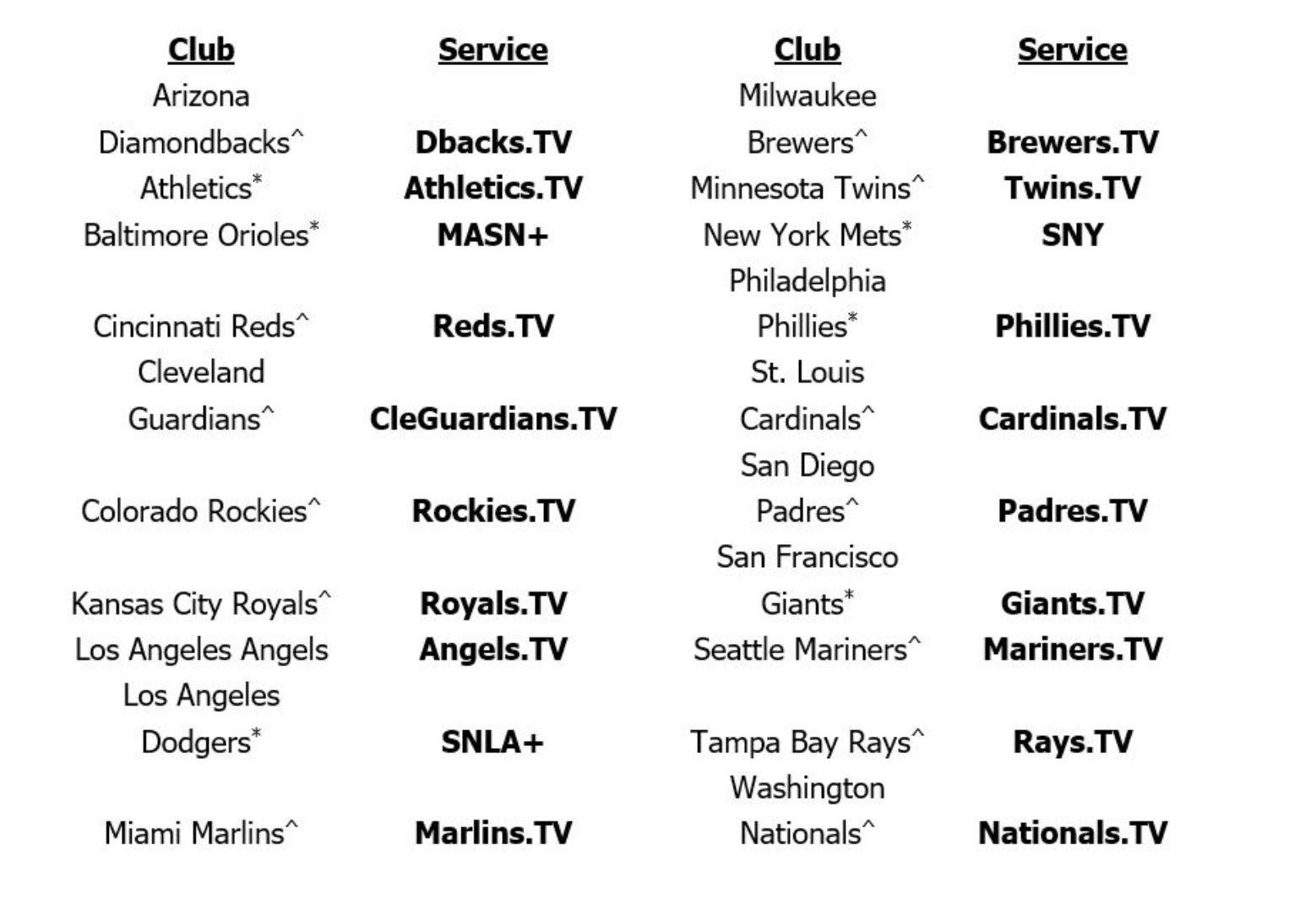
[2026 MLB Club-Level DTC Streaming Services. ^ = MLB Local Media produced; * = RSN partnership maintained]
As of the 2026 season, 21 of MLB's 30 teams already offer in-market DTC streaming subscriptions. MLB Deputy Commissioner Noah Garden stated: "Fans want blackouts eliminated. MLB's in-market streaming option allows us to remove a point of friction for the fans." The Club.TV pricing structure has been designed to be both straightforward and strategically layered.
▼ MLB Streaming Service Pricing (2026 Season)
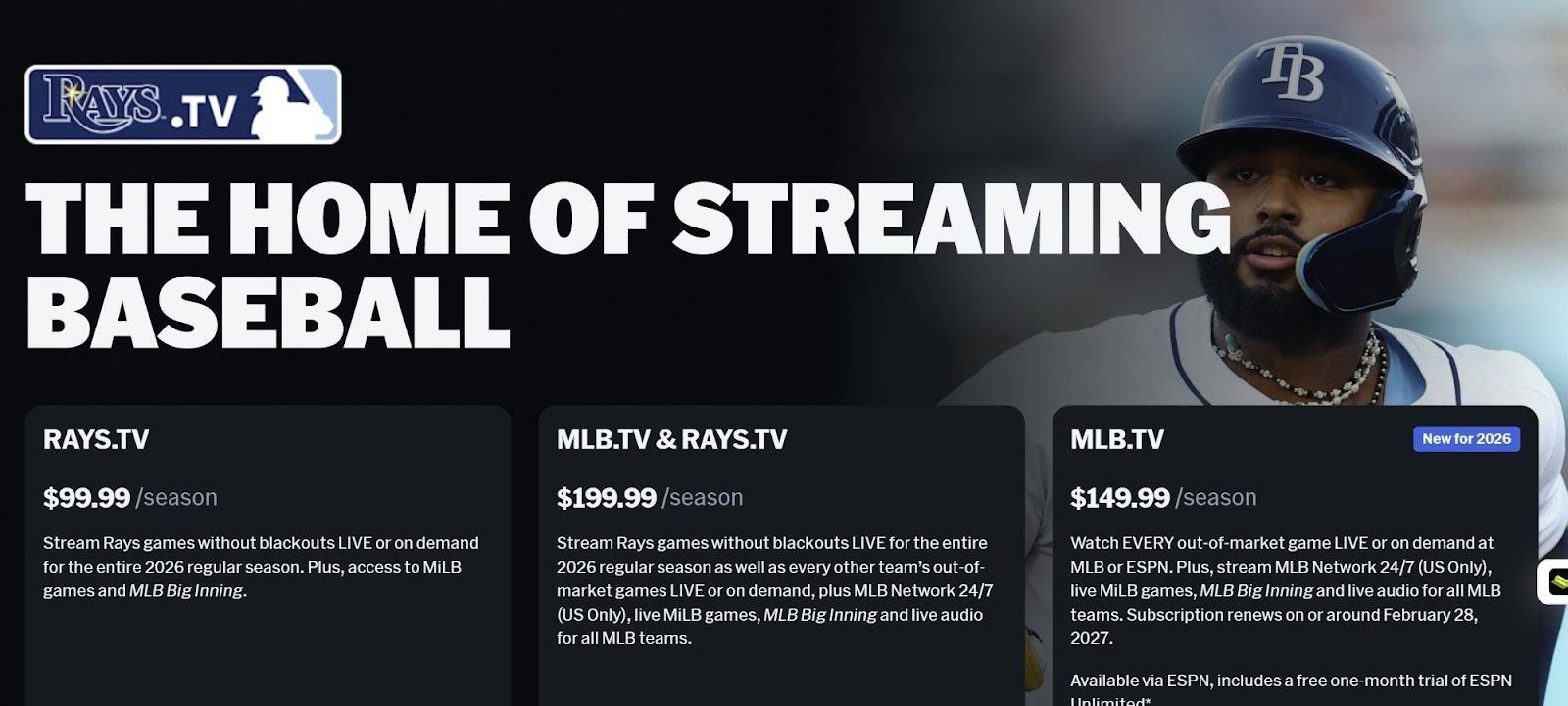
[Rays.TV pricing page: Club.TV at $99.99/season, Bundle at $199.99/season, MLB.TV at $149.99/season (New for 2026)]
Another seismic shift arrived in MLB's media architecture ahead of 2026: ESPN became the exclusive distribution partner for MLB.TV. Announced in November 2025, this deal covers the 2026–2028 seasons and is valued at approximately $550 million.
The deal's core elements are threefold. First, ESPN now holds exclusive rights to MLB.TV, delivering thousands of out-of-market games each season through the ESPN App. New subscribers must purchase MLB.TV through ESPN, with a complimentary one-month ESPN Unlimited trial included. Second, ESPN acquired in-market streaming rights for teams whose broadcasts are produced and distributed by MLB Local Media. This means local fans can also watch their team's games in the ESPN App. However, for the 2026 season, viewing remains available on MLB platforms as well. Third, ESPN will deliver 30 nationally exclusive regular-season games plus over 150 out-of-market 'game of the day' selections to ESPN Unlimited subscribers.
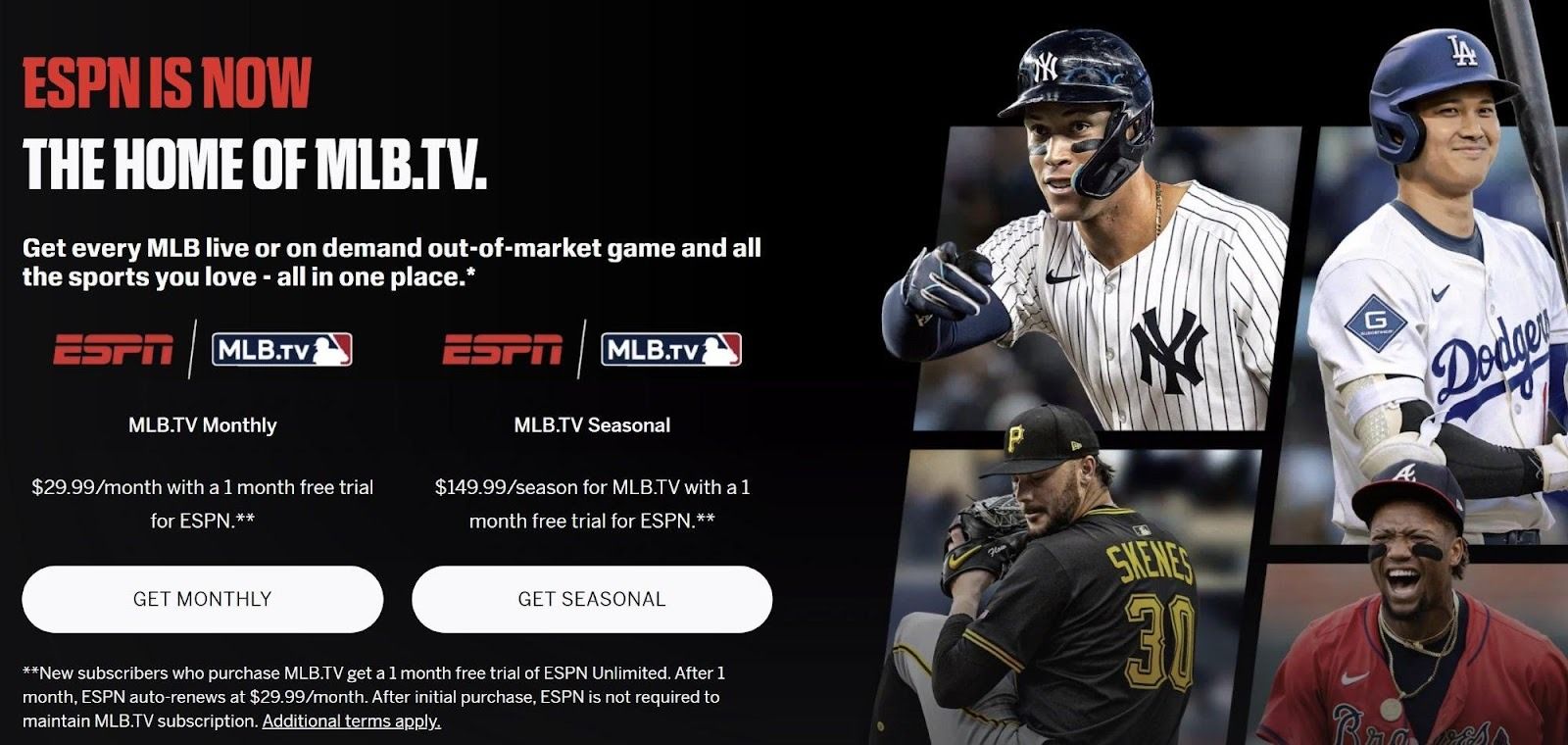
[ESPN, the new distribution home for MLB.TV: $29.99/month or $149.99/season with 1-month free ESPN Unlimited trial]
This structure aligns with Commissioner Manfred's long-term vision of progressively integrating local and national rights to maximize the league's total media value. ESPN Chairman Jimmy Pitaro has described the deal as a "fan-focused, multi-faceted agreement," expressing confidence that the ESPN App will become the central hub for baseball consumption.
Not all teams have migrated to MLB Local Media. Those that own their own RSNs or maintain stable partnerships continue to operate independent media strategies. As of the 2026 season, six teams maintain existing RSN partnerships: the Oakland Athletics (Athletics.TV), Baltimore Orioles (MASN+), Los Angeles Dodgers (SNLA+), New York Mets (SNY), Philadelphia Phillies (Phillies.TV), and San Francisco Giants (Giants.TV).
Networks where teams hold direct ownership stakes — such as the Yankees' YES Network or the Red Sox's NESN — occupy a comparatively safe position amid the RSN crisis. They are insulated from the financial distress of third-party RSN operators and retain direct control over the value of their media assets. However, even these networks are not entirely immune to cord-cutting pressures. MSG Network, which carries the New York Knicks, Rangers, Devils, Sabres, and Islanders, has reportedly struggled to refinance $829 million in debt, underscoring that even large, team-owned RSNs face challenges adapting to the new reality.
▼ 2026 MLB Team Media Distribution Classification
Revenue Collapse and the Payroll Tightening Chain Reaction
The most immediate impact of the RSN collapse hits team revenues. MLB reported in 2026 that teams which lost their RSN deals are generating approximately 50% of their former RSN rights fees under new broadcast arrangements. When a fixed income stream representing 20–30% of total revenue is effectively halved, the direct consequence is a significant reduction in player acquisition spending power.
This impact is already visible in the 2025–26 offseason. The Detroit Tigers countered two-time consecutive AL Cy Young Award winner Tarik Skubal's $32 million arbitration request with just $19 million. The Cincinnati Reds, Kansas City Royals, Tampa Bay Rays, and other teams that lost their RSN deals have shown markedly subdued offseason spending. While the collective bargaining agreement provides for some luxury tax overage redistribution to teams suffering local media revenue losses, this is insufficient as a fundamental solution. Industry experts estimate the ripple effects could widen competitive disparities across the league for years to come.
The Two Sides of the Fan Experience: Access Gains vs. Fragmentation
From the fan's perspective, the RSN collapse is a double-edged sword. On the positive side, Club.TV enables blackout-free direct streaming for the first time. Previously, fans without a cable subscription had limited legal options to watch their local team. Now, for $99.99 per season, they can watch on mobile devices, tablets, connected TVs, or any other supported device.
On the other hand, the growing fragmentation of viewing options is creating new frustrations. Some games are exclusively broadcast on national platforms — ESPN, FOX, TBS, NBC/Peacock, Netflix, Apple TV+ — and are unavailable on Club.TV or MLB.TV. To watch every single game of a favorite team, fans may need multiple streaming subscriptions, and the cumulative cost concerns are mounting. As one fan wrote on Reddit: "I am very worried this will just end up costing fans even more money to watch their favorite teams."
The collapse of the RSN model demonstrates a fundamental paradigm shift in the sports broadcasting industry. As one industry source succinctly put it: "The RSN model is dead. The future is league-controlled and digital-first."
First, leagues are rapidly internalizing their media assets. MLB now directly manages local broadcasts for more than half its teams and has signaled its intention to consolidate local and national rights by the 2028 national deal renegotiations. The NBA and NHL are exploring similar paths, with league-level apps and streamer partnerships increasingly on the table.
Second, DTC streaming is becoming the new standard for fan access. Blackout elimination, device flexibility, and reasonable pricing are transforming the fan experience. However, whether this model can generate revenue comparable to the old RSN deals remains an open question. By MLB's own reporting, current DTC revenues stand at roughly 50% of previous RSN contract values.
Third, ESPN's role is being fundamentally redefined. Once synonymous with Sunday Night Baseball, ESPN has evolved into MLB.TV's distribution platform and in-market streaming partner for numerous teams — a case study in how traditional TV networks are adapting to the streaming era.
Finally, these developments carry significant implications for the global sports media landscape, including K-Content and Korean sports industries. The core lesson of the RSN collapse is that media business models dependent on bundle subsidies are unsustainable in the cord-cutting era. Korean professional sports leagues should proactively diversify their distribution channels — through DTC streaming, FAST channels, and direct global distribution — rather than remaining tethered to traditional pay-TV dependencies. For the KBO, K League, and other Korean sports properties aspiring to build global fanbases, MLB.TV's league-level integrated streaming platform serves as a crucial reference model.
▼ Key Takeaways from the RSN Collapse
Sources & References
• ESPN, "Six teams leave regional sports network Main Street to join MLB" (Feb 2026)
• MLB.com, "A complete guide to watching MLB.TV in 2026" (Feb 2026)
• ESPN Press Room, "ESPN, MLB reach innovative new agreement" (Nov 2025)
• Sports Video Group, "A Changing Landscape: MLB Local Media" (Feb 2026)
• Cord Cutters News, "FanDuel Sports Network shutting down" (Feb 2026)
• Sports Media Watch, "SMW FAQ: How MLB TV viewing is changing in 2026" (Feb 2026)
• Boardroom, "The RSN Collapse Is Quietly Reshaping the MLB Offseason" (Jan 2026)
• Awful Announcing, "FanDuel RSNs on the verge of collapse" (Feb 2026)
• TheStreet, "Major sports TV network shutting down" (Feb 2026)
• UB Law Sports Forum, "The Life and Death of Regional Sports Networks" (Feb 2025)



![[보고서]전통 언론사의 크리에이터 전략 대전환](https://cdn.media.bluedot.so/bluedot.kentertechhub/2026/02/0nwc9z_202602100212.png)