

Hourly weekday newscasts on ch B tv · production time for a 20-minute show cut from 3+ hours to about 1 · ratings up roughly 3.4x in a year
SK Broadband now airs local news on its cable channel ch B tv 10 times each weekday, up from one evening show, using its in-house B tv AI-Studio. People write and approve scripts; AI renders voice, video and captions. A 20-minute newscast now takes about an hour, down from three-plus.
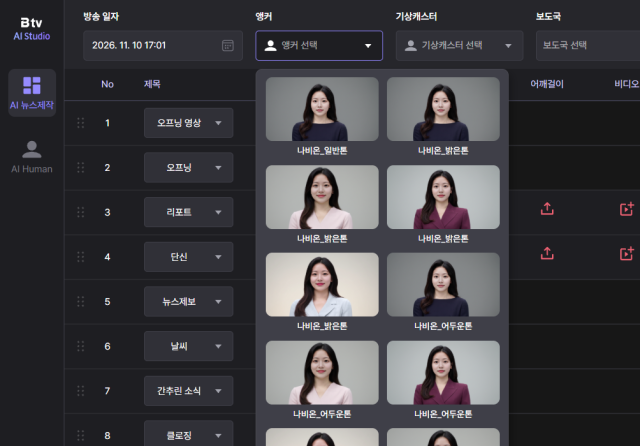
SK Broadband (SK브로드밴드), the cable and IPTV arm of SK Group, has expanded local news on its cable community channel, ch B tv, to 10 newscasts each weekday. The channel now airs local news every hour on the hour from 9 a.m. to 6 p.m. Until this year it carried a single evening newscast.
The schedule rests on a shorter production cycle. Using its in-house tool, B tv AI-Studio, the company cut the time needed to produce a 20-minute newscast from more than three hours to about one, SK Broadband said on Nov. 23. Studio lighting, camera setup, anchor makeup and voice recording drop out of the process, so a story filed from the field can make the next hourly bulletin.
From one newscast to ten, from 42nd to 10th: before and after AI
| Measure | Before AI | After AI |
|---|---|---|
| Weekday local newscasts | One evening newscast | 10 added, hourly from 9 a.m. to 6 p.m. |
| Time to produce a 20-minute newscast | 3+ hours | About 1 hour |
| Staff needed per newscast | At least 7–8 across control room, studio and anchor desk | Can be produced by one person |
| ch B tv rating | 0.08% (2025) | 0.22% (May 2026); about 3.4x year-earlier level as of October |
| Rank among B tv cable channels | 42nd | 10th |
| Local channel story count | – | Up 50.7% year over year |
Sources: SK Broadband, Asia Business Daily, Insight
As of October, ch B tv’s ratings were about 3.4 times their level a year earlier, Insight (인사이트) reported on Nov. 24. In May the company said the channel’s rating had risen from 0.08% in 2025 to 0.22%, lifting it from 42nd to 10th among channels on its cable service. After adding breaking-news feeds on its website and mobile app, the channel published 50.7% more stories than a year earlier.
Humans report and approve; AI handles voice, video and captions
SK Telecom (SK텔레콤) and SK Broadband built the tool together. Staff assemble a rundown in a web-based system, load approved scripts, and the software generates the AI anchor’s voice, on-screen video and captions. Reporters’ packages are voiced by an AI model trained on each reporter’s own voice. A news producer and a senior editor review every bulletin before it airs. Newsrooms in all of SK Broadband’s cable regions, including Seoul, Gyeonggi, Incheon, Cheonan, Sejong, Jeonju, Busan and Daegu, now use it.
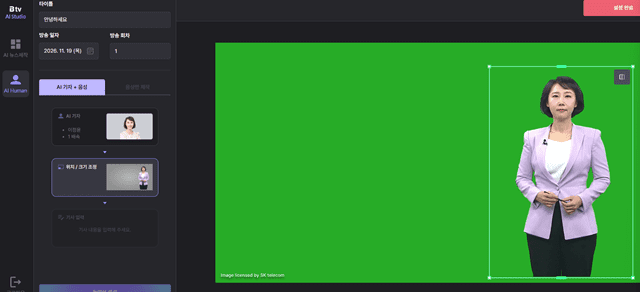
“The AI only arranges stories written by people and reports made by people into a rundown. It has no role in the content of the reporting,” Park In-seo (박인서), who heads SK Broadband’s news production division, told the Asia Business Daily (아시아경제) on Nov. 3. He said a single local newscast used to require at least seven or eight people in the control room, studio and anchor chair at the same time.
Cable subscribers fall to 11.9 million; the broadcast business has lost money four years running
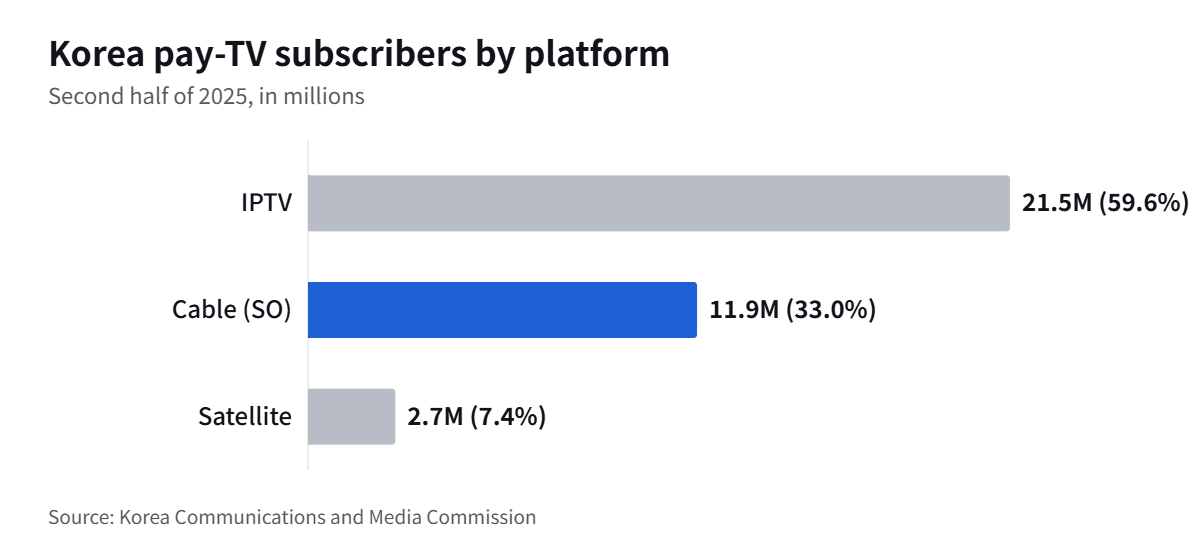
The push comes as Korea’s cable TV business shrinks. Korea had 36.15 million pay-TV subscriptions in the second half of 2025, according to the Korea Communications and Media Commission (방송미디어통신위원회). IPTV grew by about 120,000 to 21.54 million (59.57%), while cable fell by 155,820 to 11.94 million (33.01%). Cable subscriptions have dropped by 1.86 million since 2015, when they stood at 13.8 million, according to the Korea Cable TV Association.
Revenue tells the same story. Cable operators’ broadcast revenue fell 23%, from ₩2.13 trillion ($1.59 billion) in 2017 to ₩1.64 trillion ($1.22 billion) in 2025, and operating profit fell 87%, from ₩348.6 billion to ₩45.1 billion ($34 million), according to data obtained by lawmaker Kim Woo-young. In fiscal 2025, 35 of 90 cable system operators (38.9%) posted operating losses. Out of every ₩100 in subscription revenue, ₩88 goes to channel programming fees.
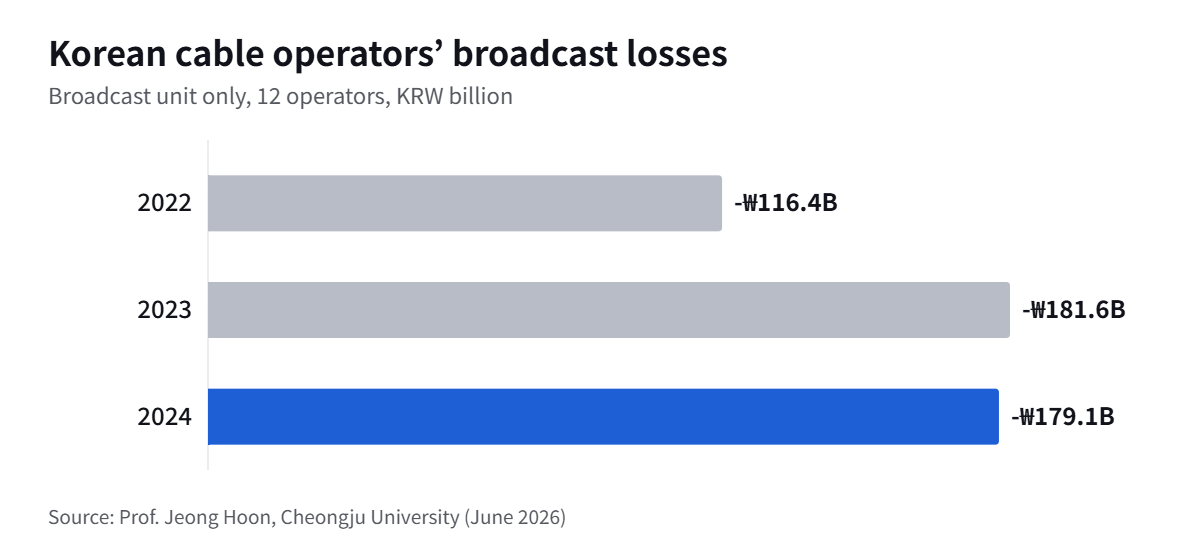
Reported results show a profit, but the broadcast business on its own loses money. Jeong Hoon, an accounting professor at Cheongju University, separated broadcast from non-broadcast accounts at 12 operators and found broadcast operating losses of ₩116.4 billion in 2022, ₩181.6 billion in 2023 and ₩179.1 billion ($134 million) in 2024. Non-broadcast revenue such as broadband and appliance rentals rose from 35.4% to 40.1% of the total over the same period.
₩120 billion a year for local channels across 77 districts
Korea’s Broadcasting Act (Article 70) requires cable operators to run community channels that produce local information and programming. Operators spent about ₩120 billion ($90 million) on those channels last year, according to the industry. The channels are split into 77 city, county and district zones, the narrowest coverage areas of any Korean broadcast medium. Operators also pay 1.5% of broadcast revenue into the Broadcasting and Communications Development Fund whether or not they make money.
“Cable operators are the media that can report on the most granular local level, the city, county and district,” Kim Yong-hee, a professor at Sun Moon University, said on Nov. 17, warning that their decline could weaken local news, disaster and election information, and local video archives. AI production that adds newscasts without adding staff is a response to those conditions.
LG HelloVision turns public data and CCTV feeds into neighborhood news
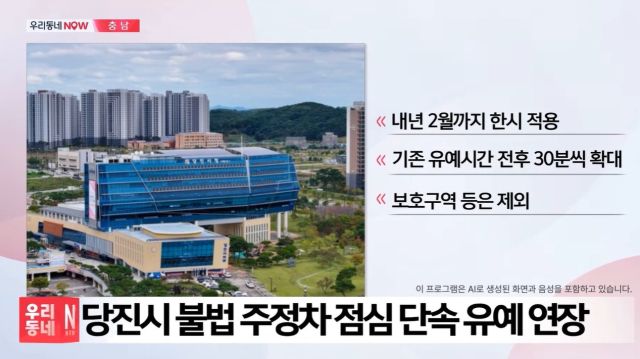
Rival cable operator LG HelloVision (LG헬로비전) is applying AI to its local channel, Hello TV News. Its system collects and analyzes data published by local governments, the Korean National Police Agency, the transport ministry and the Korea National Park Service, and turns local-government press releases into short clips that combine narration, photos and video for a segment called “Woori Dongne NOW” (Our Neighborhood Now). Producers review each AI-built clip before broadcast. The company also plans to link about 8,000 CCTV feeds nationwide to use live footage in wildfire and typhoon bulletins, ZDNet Korea reported.
Government backs AI production at eight regional broadcasters
On July 31 the Korea Communications and Media Commission picked eight broadcasters and eight projects for a pilot program supporting AI production at regional broadcasters. The selected stations will apply AI across planning, filming and editing, after AI production training in seven regions. The Ministry of Culture, Sports and Tourism raised its 2026 budget for regional and small broadcasters to ₩20.5 billion ($15 million), 2.5 times the previous year.
U.S. station groups are using AI to keep local schedules full
American local broadcasters are moving in the same direction. When E.W. Scripps announced layoffs in August, it said it would convert 12 local stations to 24-hour local news streams built on AI and automation and extend the model across its portfolio. At NAB Show New York in October, Scripps and CNN said human verification, down to the source document and the original recording, comes before any newsroom AI rollout (K-EnterTech Hub, Oct. 29).
“Technology lets more people create more local content,” Mike Braun, chief digital officer of Gray Media, which operates stations in 117 TV markets, said at the same event (related story). The supply of local news is shrinking as well: Northwestern University’s Medill Local News Initiative counted 238 U.S. counties with no local news outlet in its State of Local News 2026 report, up 26 in a year (related story).
| Company | What AI does | What people do | Scale |
|---|---|---|---|
| SK Broadband | Turns approved scripts into AI anchor voice, video and captions | Reporting, editor approval, producer review | All cable newsrooms; 10 hourly weekday newscasts |
| LG HelloVision | Collects public data; turns press releases into short clips | Producer review; reporting on viewer tips | Plans to link about 8,000 CCTV feeds |
| E.W. Scripps | 24-hour local news streams built on AI and automation | Final responsibility for output (company guidelines) | 12 stations first, then all |
| Gray Media | One platform for web, app and smart-TV services in 117 markets | Expanded local reporting | 1,300 digital touchpoints |
Sources: company disclosures, ZDNet Korea, K-EnterTech Hub
Next: expressive anchors and automated weather reports
SK Broadband is developing options to match an AI anchor’s expression and outfit to the tone of a story, automatic weather reports built from Korea Meteorological Administration data, and speech-recognition captioning. The company plans to publish guidance next year on how it tells viewers that AI was used, the Asia Business Daily reported.
Korean cable community channels are losing subscribers and revenue while still carrying a duty to cover every city, county and district. AI at SK Broadband and LG HelloVision started with faster production and is moving into automated weather and disaster information, and the government pilot is set to carry the approach to more regional broadcasters.
Feature photo: Local Roasting, a ch B tv program produced with AI tools. Photo: SK Broadband