

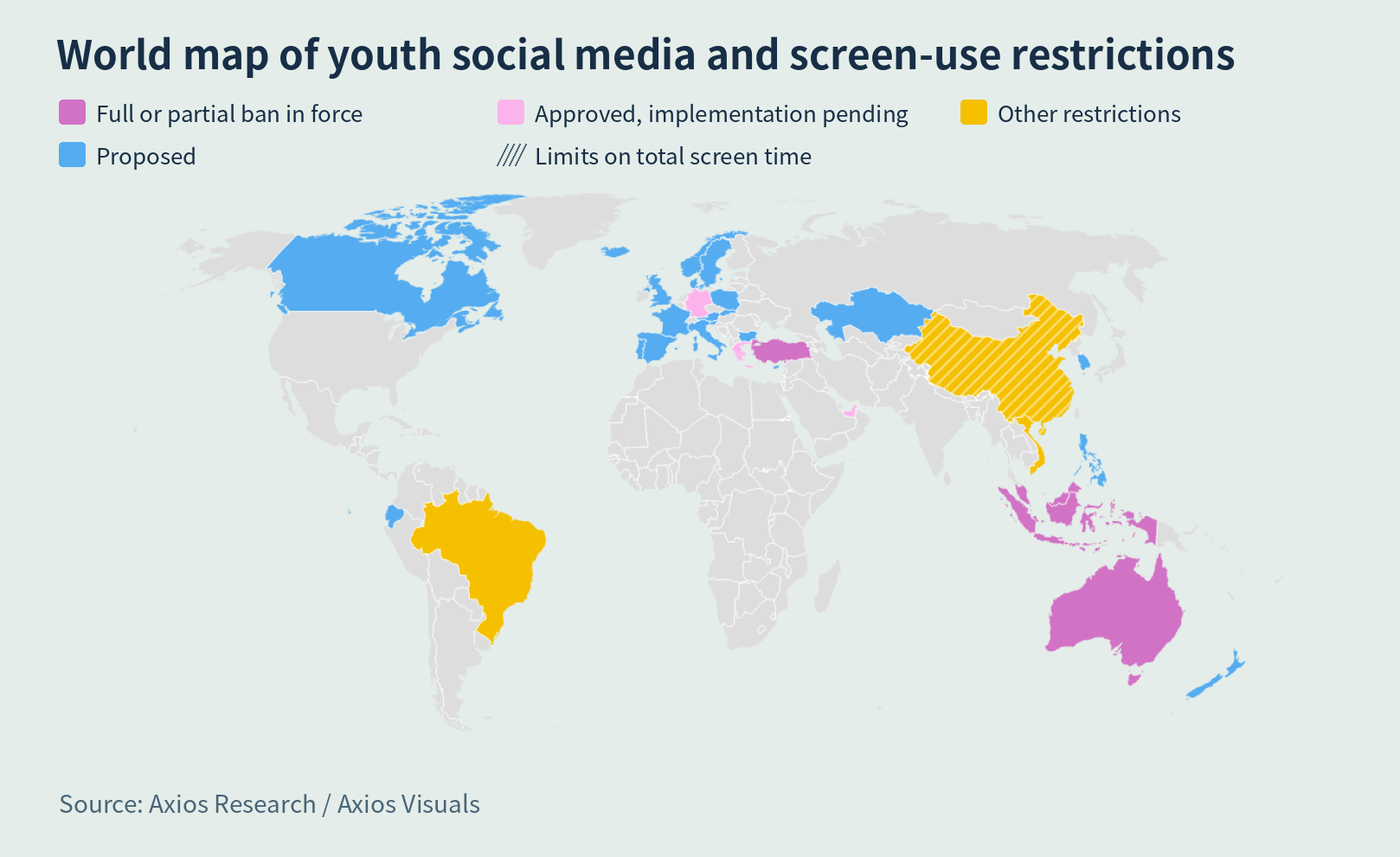
About 4.7 million social media accounts were restricted in the first half of December 2025 as Australia rolled out its under-16 account rule. Britain plans to follow Australia, the European Commission has proposed separate thresholds at 13 and 15, and France’s Constitutional Council struck down the core provision of its under-15 ban.
South Korea restricts smart devices in class. In the U.S., Meta’s multistate settlement reaches into time limits and feed design, while the EU already restricts profiling-based ads to minors. For video platforms, the rules can change who signs up, what brings viewers back, and how much revenue platforms earn from their attention.
Australia’s 4.7 million accounts tell an enforcement story
Since December 10, 2025, covered platforms such as Instagram, TikTok and YouTube have had to take reasonable steps to prevent Australians under 16 from holding accounts. Public material can remain available without a login. Australia’s eSafety Commissioner reported that about 4.7 million accounts were restricted in the first half of December. One person can hold several accounts. In November 2026, eSafety was still investigating Facebook, Instagram, Snapchat, TikTok and YouTube. Account data · November update
Enforcement extends to existing accounts, appeals against incorrect age decisions and the handling of age-assurance data. The count of restricted accounts cannot by itself show changes in screen time, displacement to another service or mental health outcomes.
The UK, EU and France take different paths
The UK’s September plan follows Australia’s under-16 model and would restrict features such as livestreaming and unsolicited contact on certain other services for under-18s. The European Commission’s EU KIDS Act proposal restricts social media provision to under-13s and puts the independent account threshold at 15. UK government factsheet · European Commission proposal
France’s parliament passed an under-15 ban in July. Its Constitutional Council struck down the central provision in August on freedom of expression and privacy grounds, leaving other provisions, including a digital break in high schools, intact. Constitutional decision summary
The EU’s Digital Services Act already affects the advertising business. Article 28 prohibits ads based on profiling with personal data where a platform is reasonably certain the recipient is a minor. The Commission’s guidelines address recommender systems and autoplay. Contextual placements remain a possible sales route, with reach, pricing and performance that advertisers will have to assess on their own terms. DSA Article 28 · Commission guidelines
In the U.S., product design is part of the settlement
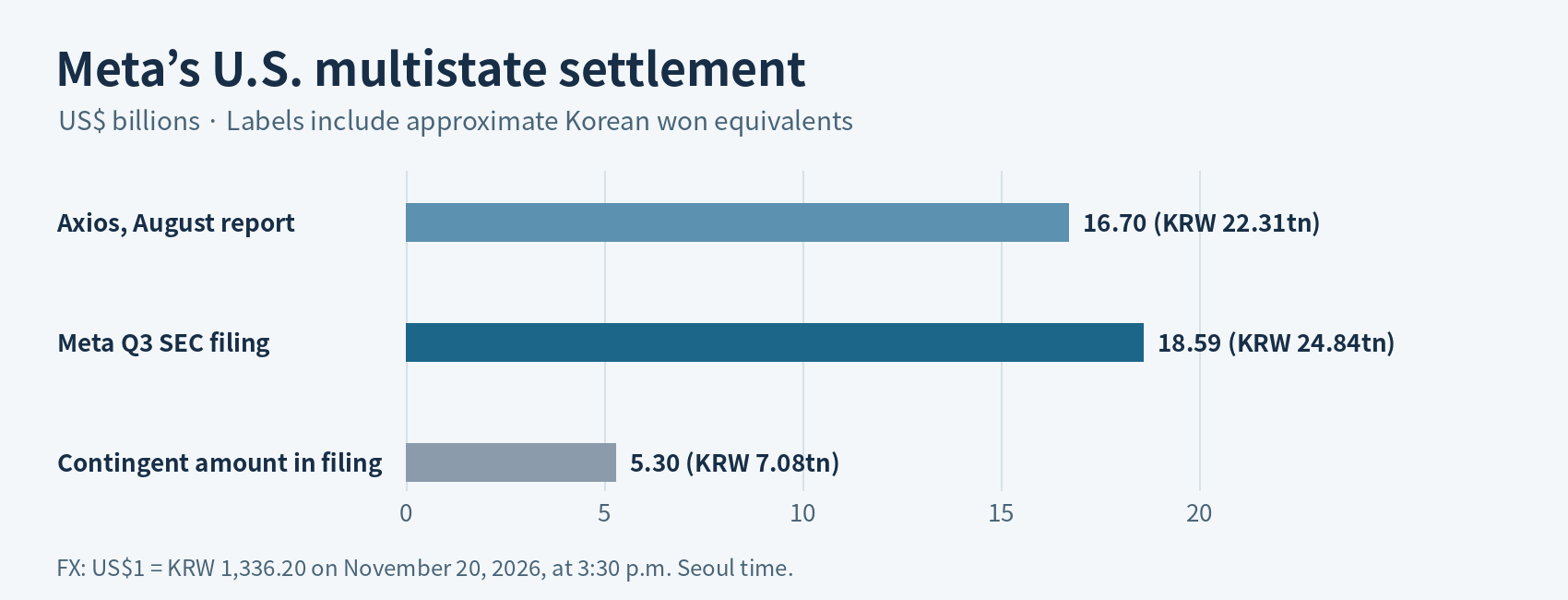
Axios reported in August that Meta had reached a settlement of up to US$16.7 billion (about KRW 22.31 trillion). Meta’s subsequent SEC filing disclosed a maximum of approximately US$18.59 billion (about KRW 24.84 trillion) under an agreement with 52 attorneys general. Around US$5.3 billion (about KRW 7.08 trillion) was contingent on industry peers taking certain steps, including qualifying peer payments. Conditions had not been met as of September 30. Axios reported terms including a two-hour daily limit, an overnight block and a chronological feed option for U.S. Facebook and Instagram users under 18. Axios settlement report · Meta’s SEC filing
| Source | U.S. dollars | Korean won equivalent |
|---|---|---|
| Axios, August report | Up to US$16.7 billion | About KRW 22.31 trillion |
| Meta Q3 SEC filing | Up to about US$18.59 billion | About KRW 24.84 trillion |
| Contingent amount within filing ceiling | About US$5.3 billion | About KRW 7.08 trillion |
Conversion uses US$1 = KRW 1,336.20 at 3:30 p.m. Seoul time on November 20, 2026. Exchange-rate source
The U.S. House passed H.R. 7757 in June. Separately, the FTC’s amended COPPA rule requires covered operators to obtain separate verifiable parental consent before disclosing personal information from children under 13 to third parties for targeted advertising and other covered purposes. New York’s final rules, scheduled to take effect January 25, 2027, restrict personalized feeds and overnight notifications for under-18s without parental consent. Congressional Research Service · FTC · New York attorney general
South Korea’s classroom rule addresses device use
Axios marks South Korea as a market with proposed measures. Separately, Korea’s education law restricts smart devices in class, with school-authorized exceptions for assistive use, education and emergencies. Korean education law
For short-form video platforms, account limits may affect logged-in recommendations and new follows. Autoplay and notification rules can affect session length and return visits. Limits on ad profiling can change revenue earned from the same viewing time. Age-segmented sign-ups, logged-in and logged-out viewing, referrals from search and recommendations, and ad impressions and prices by targeting method can show which part of the business moves.
| Market | Status and scope |
|---|---|
| Australia | In force · under-16 accounts on covered services |
| UK | Government plan · under-16 social media and selected under-18 features |
| EU | DSA applies · separate EU KIDS Act proposal sets thresholds at 13 and 15 |
| France | Central under-15 access provision struck down |
| U.S. | Multistate settlement and COPPA Rule |
| South Korea | Classroom device restrictions in force |