
Read in other languages 한국어 · 日本語 · 繁體中文
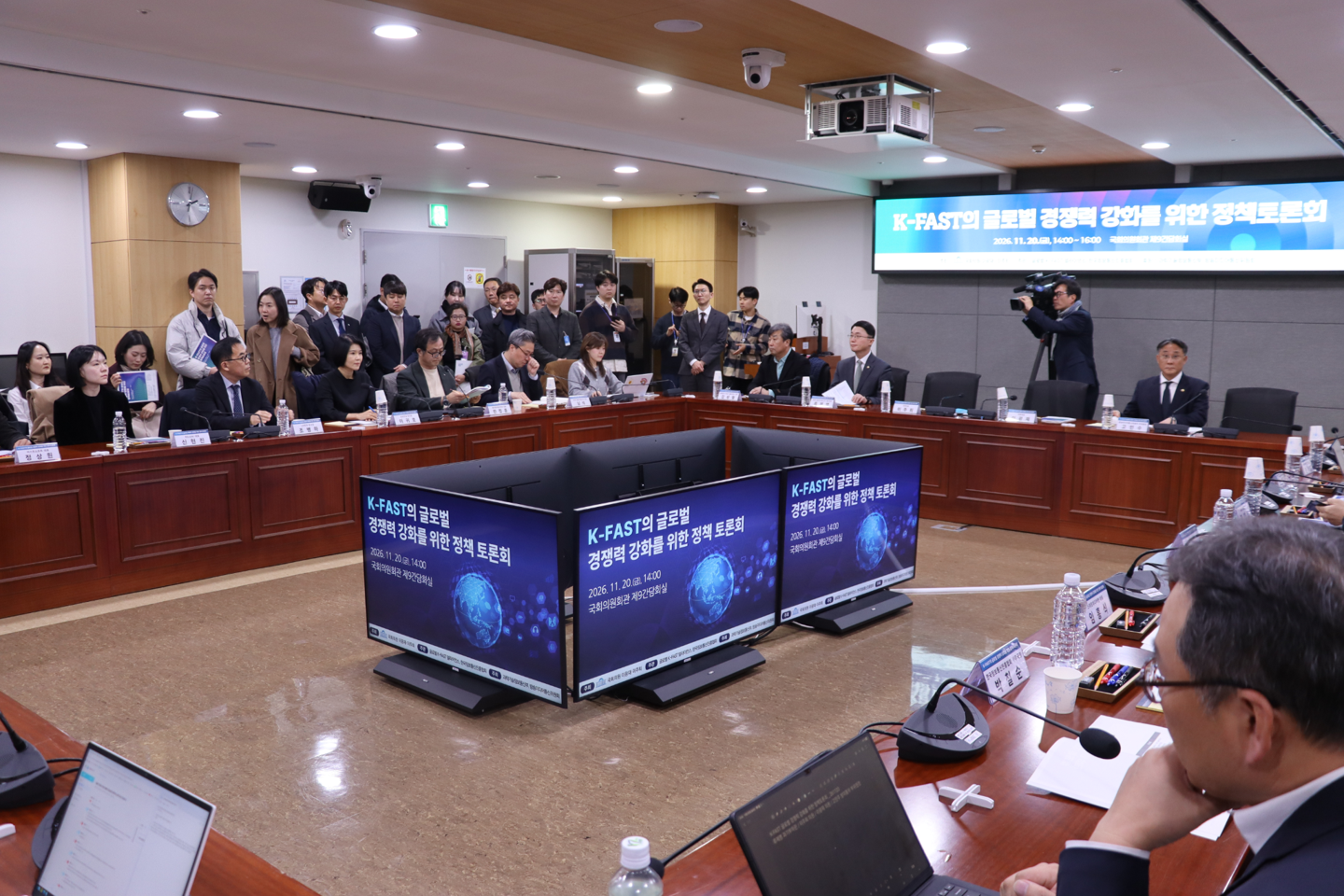
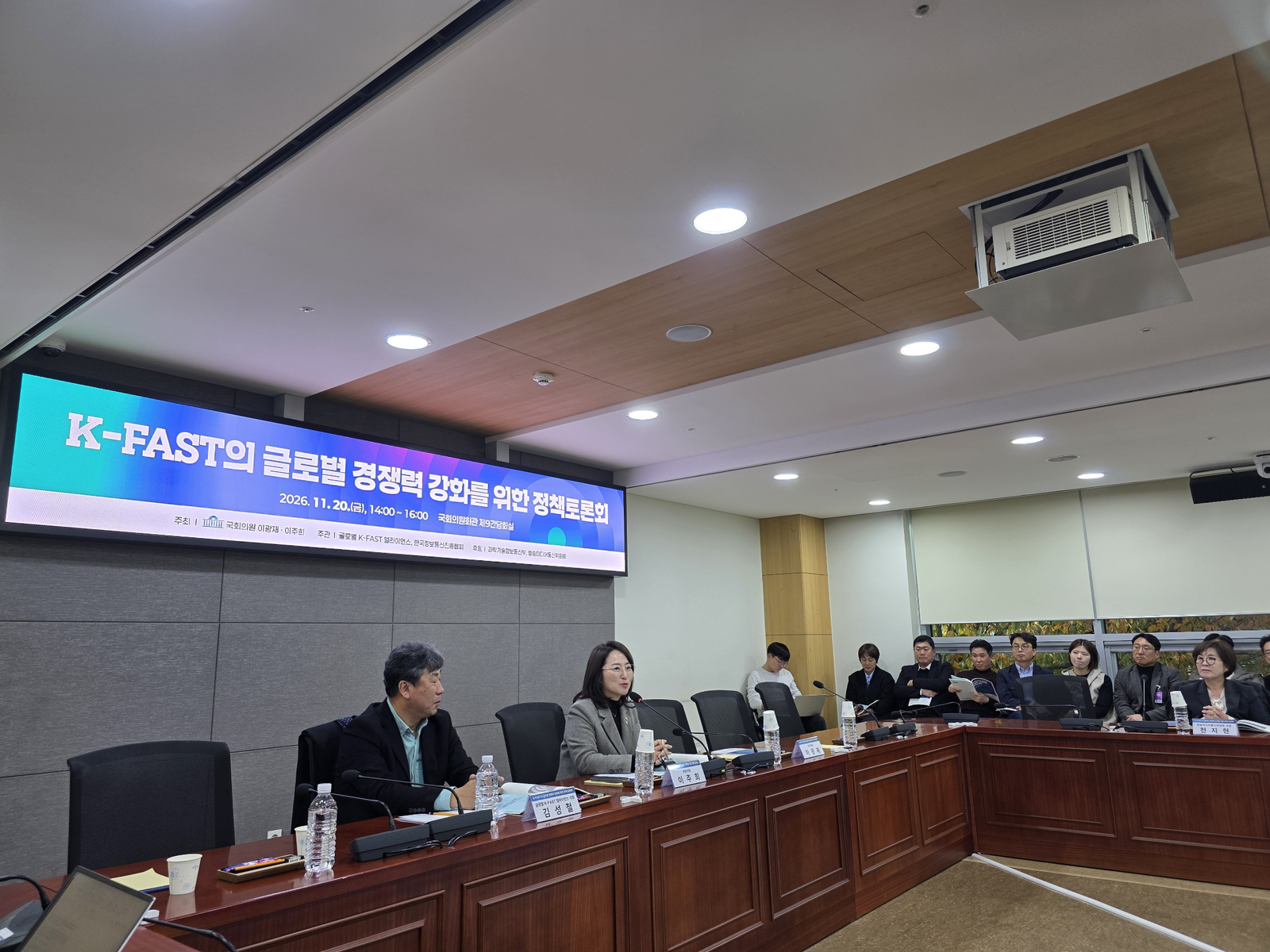
Korea’s publicly backed K-FAST initiative has put 20 free, ad-supported streaming channels on air in 22 countries. A National Assembly forum on November 20 put cumulative viewership through September at 290 million. Co-host Lee Ju-hee said she had raised the omission of K-FAST funding from the government’s draft 2027 budget during a parliamentary audit and requested support during budget review. The forum, held at the National Assembly Members’ Office Building, was co-hosted by Lee and Lee Kwang-jae and organized by the Global K-FAST Alliance and KAIT.
The policy question is what happens after a channel launches. Producers pay for dubbing, rights and localized program information before advertisers buy inventory. Lee called for data on which titles audiences choose and how long they watch, revenue sharing that reflects each partner’s contribution, and participation by smaller producers.
| 2025 support program | Reported result |
|---|---|
| Localization | About 1,200 titles or episodes, 1,400 hours |
| Distribution | 20 channels in 22 countries |
| Cumulative viewers | About 100m at end-April, 290m at end-September |
Sources: Forum materials and Ministry of Science and ICT.
A bigger FAST market, with different audiences in each country
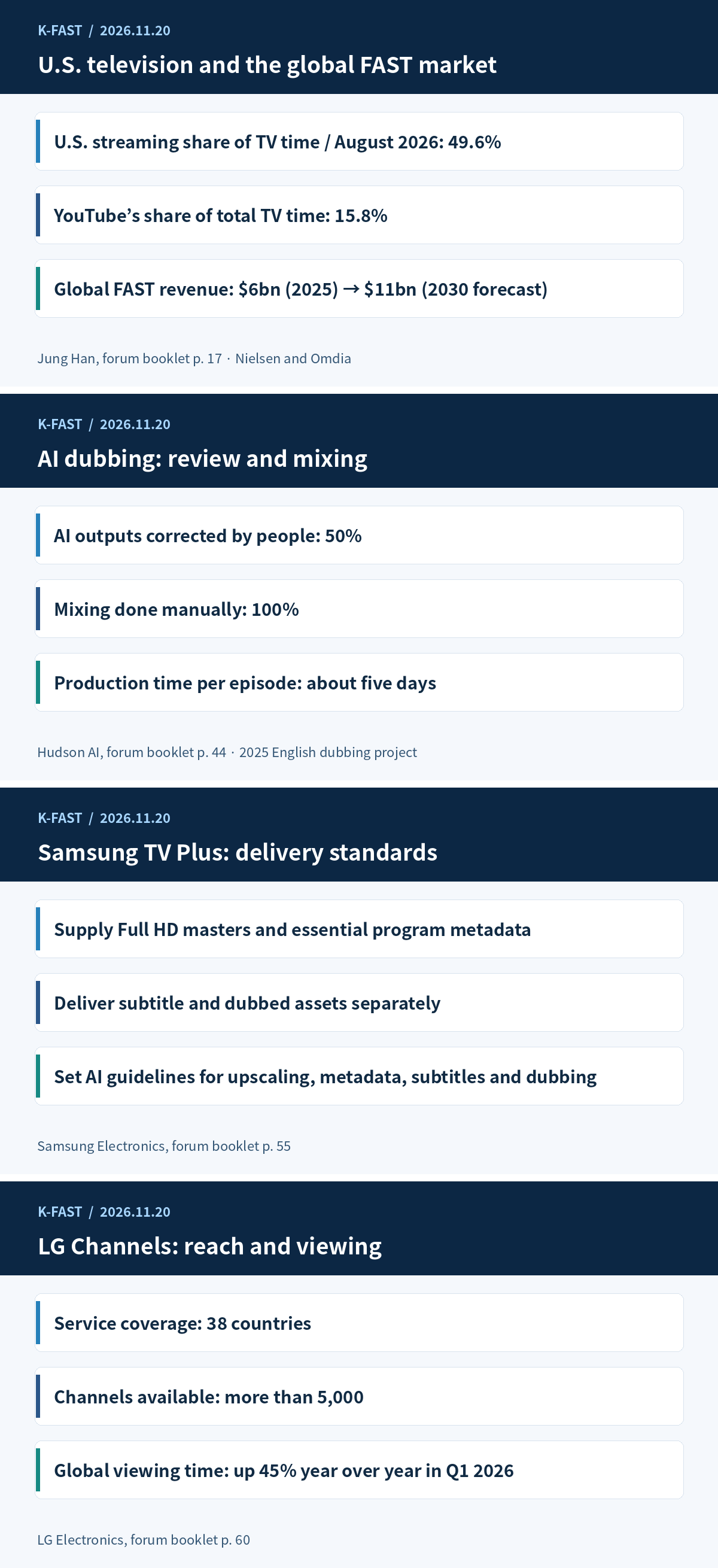
K-EnterTech Hub CEO Jung Han cited Nielsen figures showing streaming accounted for 49.6% of U.S. TV viewing in August 2026 and YouTube for 15.8% of total viewing. Omdia projects global FAST revenue rising from $6 billion in 2025 to $11 billion in 2030. Monthly FAST reach among online adults varied from 35% in Spain to 26% in the UK, 25% in Germany and 17% in France. Han said live sports and events give advertisers a defined slot to buy, whereas library drama, variety and K-dance sustain a schedule and reach different audiences.
Omdia’s $11 billion forecast covers the entire global FAST market. What an individual Korean channel can earn depends on how much time viewers spend with it and how much of its ad inventory actually sells locally. Live sports and concerts can draw audiences during hours advertisers want to buy, while library dramas and variety shows keep the weekday schedule full. Tracking which lineups deliver both viewing time and ad sales gives programmers a basis for investing in the next season.
| Global market | 2025 | 2030 forecast |
|---|---|---|
| FAST revenue | $6bn | $11bn |
| Connected-TV ad revenue | $44bn | $81bn |
Source: Forum presentation citing Omdia. CTV advertising spans a broader market than FAST.
| U.S. viewing and the global FAST market | |
|---|---|
| Streaming share of U.S. TV viewing | 49.6% |
| YouTube share of total TV viewing | 15.8% |
| Global FAST revenue | $6bn → $11bn |
| Source: Jung Han’s presentation, p. 17, citing Nielsen and Omdia | |
Latin America market data In January 2026 Omdia put Brazil’s FAST revenue at $152 million, third globally behind the U.S. and U.K. A Spanish-language rollout alone therefore tells a Korean operator little about the economics of a Portuguese-language channel in Brazil.
Samsung’s delivery standards and LG’s market-by-market economics
Samsung executive Lee Gwi-ho described a cycle of content partnerships, promotion, targeted TV advertising and revenue sharing. Samsung TV Plus passed 100 million global monthly active users in January, the company said, and 2025 viewing hours rose 25%. Samsung proposed Full HD masters, essential metadata, and separate subtitle and dubbed assets, alongside guidelines for AI editing. LG executive Cho Byung-ha said LG Channels offered over 5,000 channels in 38 countries. Company figures put first-quarter 2026 user growth at 30% and viewing-time growth at 45% year over year. Spanish-language programming in Latin America and K-dance in North America illustrate how localization needs and ad economics vary.
Samsung and LG address two stages of the same distribution decision. Common specifications for masters, subtitles, dubbed audio and program metadata can cut the cost of preparing a title for each new platform. The next question is whether the title can pay its way in each market. A dance lineup that works in North America, for example, would have to cover its language-specific production costs through local ad sales if expanded into Latin America. Common delivery specifications make it easier to compare those results title by title.
The commercial work begins once a show is on the schedule. Samsung executive Lee outlined a sequence that starts with a content partnership, uses promotion to bring viewers in, and ends with advertising revenue shared with the supplier. Samsung runs dedicated Korean-content sections in some markets and promotes titles through outdoor placements such as Times Square and Piccadilly Circus, as well as in stores and online. Lee also cited a partnership with SMTOWN that brought regularly scheduled free concerts to the service and expanded into musicals. A dedicated destination and searchable program information can help turn a visit for a concert into a viewing session that includes other Korean titles.
Lee also pointed to a delay that starts before launch. When a platform commissions subtitles or dubbing after it receives a title, it can take time to clear the changes and check that they reflect the creator’s intent. Delivering language files approved by the rights holder alongside the master can make it easier to coordinate releases. LG executive Cho’s examples show where those files might pay off first. LG worked with CJ ENM on a K-dance channel in North America, while an MBC K-drama channel ranked among the more-watched services in Peru. Europe brings more languages and more competition from local broadcasters. Emerging markets can bring strong demand for dubbing alongside lower ad rates. A follow-on program could track time to launch, localization cost and actual ad revenue by market to guide which titles and languages to fund first.
| Platform presentation | Key findings |
|---|---|
| Samsung TV Plus | Full HD masters, essential metadata and separate subtitle/dubbing files |
| LG Channels | 38 countries, 5,000+ channels, Q1 2026 viewing hours up 45% year over year |
Source: Samsung and LG forum presentations.
| Samsung TV Plus delivery standards | |
|---|---|
| Content providers | Full HD masters, metadata, separate subtitles and dubs |
| Platform AI | Upscaling, metadata, subtitles and dubbing |
| Distribution goal | Bring Korean programming to global audiences |
| Source: Samsung’s forum slides, p. 55 | |
| LG Channels distribution and growth | |
|---|---|
| Countries | 38 |
| Channels available | More than 5,000 |
| Q1 2026 viewing time | Up 45% year over year |
| Source: LG’s forum slides, p. 60 | |
The cost of dubbing and the cost of being hard to find
Hudson AI CEO Shin Hyun-jin said people corrected half of the outputs in its 2025 English dubbing work, all mixing was manual and one episode took about five days. The proposed workflow lets AI flag and retry timing and translation issues before human approval. ESTsoft CEO Chung Sang-won discussed emotional delivery and rework in drama. Gracenote reported that viewers in its six-country survey spent 12 minutes on average searching for something to watch, rising to 15 minutes among 18- to 24-year-olds. A local title, cast and episode information need to work across search and channel guides.
Counting dubbed episodes tells a support program how much it commissioned. To find out what dubbing adds, operators could schedule subtitled and dubbed versions of the same title in comparable time slots and measure viewing hours and ad sales. Pairing SMR’s short-term trial with CJ ENM’s proposal to track individual titles would give producers evidence for deciding which shows merit a new season or another language version.
| 60 minutes of video, one language | Indicative cost |
|---|---|
| Traditional voice-actor dubbing | KRW 4.8m–9m |
| AI-assisted dubbing | KRW 1.8m–3.6m |
Source: ESTsoft’s indicative costs in the forum booklet.
| AI dubbing bottleneck: review and mixing | |
|---|---|
| AI outputs corrected by people | 50% |
| Mixing completed manually | 100% |
| Production time per episode | About five days |
| Source: Hudson AI slides, p. 44, 2025 English dubbing work | |
Broadcasters want to share costs and test original programming
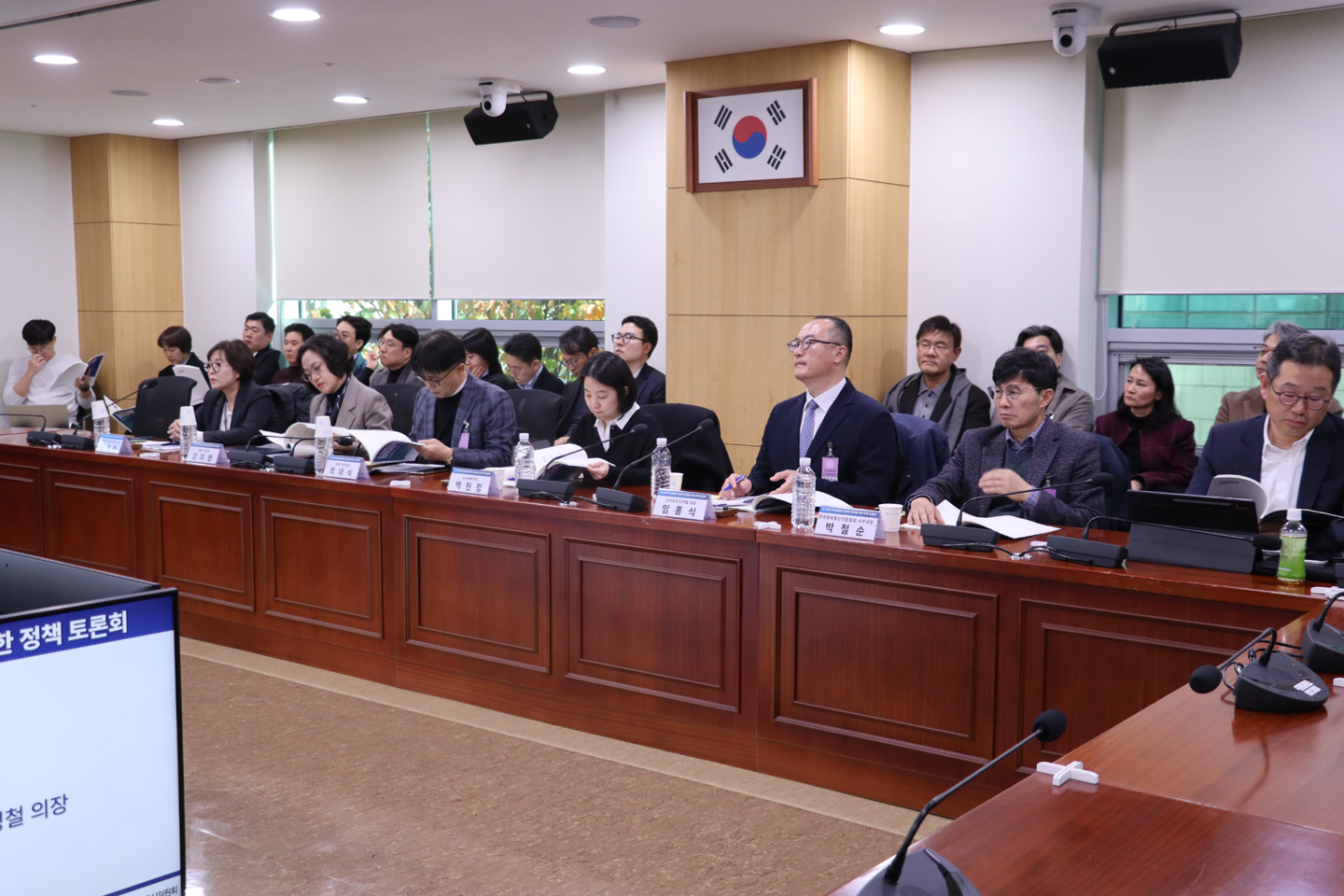
MBC’s Kang Mi-young described a three-broadcaster launch in seven English-speaking markets, supported by Smart Media Rep (SMR). SBS’s Choi Dae-sik proposed TV manufacturers invest in original drama and entertainment for international FAST users. CJ ENM’s Baek Hyun-jung called for tracking actual titles through AI localization, overseas scheduling and ad sales. SMR’s Lim Hong-sik reported a short trial in which adding dubbed programs lifted viewing time about 30% to 80%.
What 2027 support should deliver
Second Vice Minister Ryu Je-myung outlined AI localization support and tests of dedicated short-form and live channels. Vice Chair Ko Min-soo of the Broadcasting, Media and Communications Commission proposed using viewing data to develop titles for overseas audiences and testing AI ad services. Nam Seok, director general for telecommunications policy at the Ministry of Science and ICT, pointed to the combination of Korean content, smart-TV home-screen distribution and AI dubbing and subtitling. The next funding round should make it possible to see what sold in each market, how much reached producers and where an original or another dubbed title can pay for itself.
A 2027 program could fund a localized version and searchable program metadata together, then ask platforms to report ad sales, localization costs and payments to producers by market. A producer should be able to see, for example, whether the M
exican channel earned back what it spent on Spanish dubbing and rights clearance. That is the evidence it needs to commission another title and turn a publicly backed launch into repeat business.