

Cover photo: iPad Pro in use, 2025. Photo: Apple.
New tablet launches have failed to halt a sharp market contraction. Tighter component supply is limiting both shipment volumes and the scope for meaningful upgrades, weakening the case for consumers to replace their devices. For vendors, securing supply and offering a clear reason to buy are becoming as important as introducing new models.
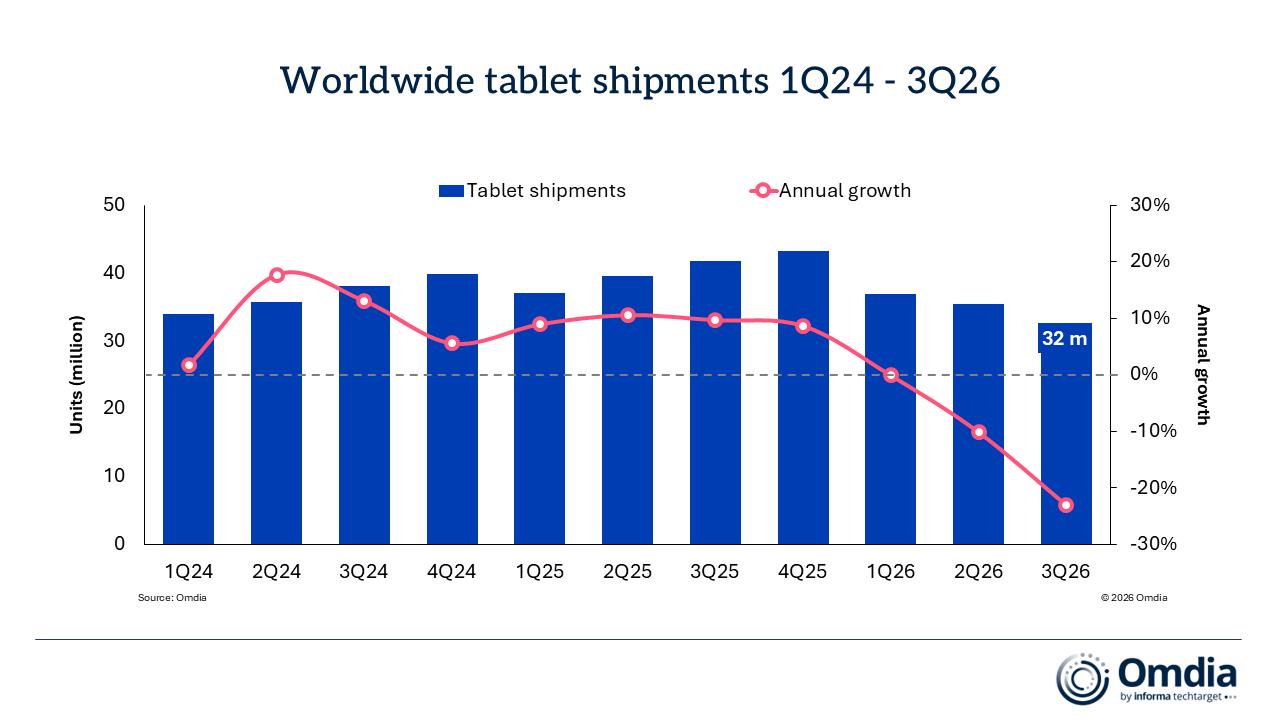
Global tablet shipments fell 23.0% year on year to 32.191 million units in the third quarter of 2026, their lowest level in nearly three years, according to Omdia research published on November 5 and distributed in Korea on November 12. The Middle East, China and Western Europe suffered the sharpest declines.
The fall followed a 10% decline in the second quarter. Himani Mukka, research manager at Omdia, said intensifying supply constraints were pushing tablets down vendors’ strategic priorities for 2026 and 2027. With supply expected to tighten further, Omdia considers a meaningful recovery unlikely before 2028.
Lenovo gains while Apple and Samsung contract
Apple retained first place with 11.581 million shipments, down 27.5% from a year earlier. Its share fell from 38.2% to 36.0% as its decline outpaced the market. Samsung shipped 5.425 million tablets, down 21.7%, but edged up from 16.6% to 16.9% share. Omdia said component constraints continued to weigh on Samsung despite new product launches.
Lenovo was the only top-five vendor to grow. Shipments rose 11.9% to 4.093 million units, lifting its share from 8.7% to 12.7%, a four-percentage-point increase. Slate tablets drove growth despite a sharp drop in detachables. Sell-in increased in every region except Europe and Latin America.
Xiaomi shipped 2.346 million units, down 10.6%, while its share rose from 6.3% to 7.3%, supported by Latin America. Huawei recorded the steepest top-five decline, falling 43.0% to 1.848 million units, although it continued to grow in Central and Eastern Europe and Asia-Pacific.
Worldwide tablet shipments and market share
| Vendor | Q3 2026 shipments | Share | Q3 2025 shipments | Share | YoY change |
|---|---|---|---|---|---|
| Apple | 11,581 | 36.0% | 15,979 | 38.2% | -27.5% |
| Samsung | 5,425 | 16.9% | 6,929 | 16.6% | -21.7% |
| Lenovo | 4,093 | 12.7% | 3,658 | 8.7% | +11.9% |
| Xiaomi | 2,346 | 7.3% | 2,623 | 6.3% | -10.6% |
| Huawei | 1,848 | 5.7% | 3,243 | 7.8% | -43.0% |
| Others | 6,897 | 21.4% | 9,380 | 22.4% | -26.5% |
| Total | 32,191 | 100.0% | 41,813 | 100.0% | -23.0% |
Shipments in thousands. Shares may not sum to 100% due to rounding. Source: Omdia PC Horizon Service, November 2026; sell-in shipments.
Supply limits weaken the upgrade proposition
Omdia said major launches in the second half of the year had done little to stimulate demand in difficult conditions. Persistent supply constraints also restrict vendors’ ability to make substantial specification improvements. With fewer compelling differences between generations, consumers have less incentive to replace existing devices.
These are sell-in shipments to distribution channels, not final retail sales. The figures alone do not separate the respective effects of supply constraints and softer demand. Lenovo’s growth also shows that product mix and regional execution can produce different results within a shrinking market.
Content companies should focus on the installed base
Tablets are screens for video, webtoons, books and games. A decline in shipments does not, by itself, establish a decline in content consumption. The research does not measure time spent on existing devices or spending on paid services.
For content and platform businesses, the implication is to review growth assumptions tied to new hardware sales. Longer replacement cycles make reliable playback, app performance and usable interfaces on existing devices more important. Korean content companies should track device shipments separately from actual engagement and payment metrics.
Jung Han | CEO, K-EnterTech Hub · EnterTech journalist
Sources
Also read
4BY4 brings AI video enhancement to Mac, DaVinci Resolve and Nuke